Dreaming of watching the Italian countryside glide by from the comfort of a train, a coffee in hand? Train travel in Europe is as romantic as it sounds, but figuring out how to buy tickets can feel like a daunting puzzle. If you’re researching how to travel in Europe by Train, this is where the real decision begins.
Travel Europe by Train: Routes & Pass Tips
This confusion almost always boils down to one fundamental choice: buying a multi-use rail pass (like Eurail) or booking individual ‘point-to-point’ tickets for each leg of your journey.
What most first-time travelers don’t realize is that for many popular trips, skipping the famous pass is actually cheaper and simpler.
The right answer depends entirely on your specific plans. This guide will help you decide between a pass and individual tickets, avoid common costly mistakes, and give you the confidence to book your perfect European train adventure.
The Single Most Important Decision: Is a Europe Rail Pass Worth It?
When you start planning, you’ll quickly face the biggest question in European train travel: Should you buy a rail pass that covers multiple journeys, or should you book individual tickets? The answer depends entirely on your travel style and budget.

The most straightforward option is buying Point-to-Point tickets.
This works exactly like booking a flight—you buy a single ticket for a specific journey from City A to City B on a set date and time. This method is often cheaper if your itinerary is fixed and involves only a few short trips.
On the other hand, a Rail Pass (like the popular Eurail Pass for non-European residents) is like an all-you-can-ride buffet for trains. You pay a single upfront price for a set number of travel days, giving you incredible flexibility.
A simple rule of thumb: if you plan on taking four or more long-distance train journeys, a pass often becomes the more cost-effective choice. To help you decide, see which of these statements sounds more like your dream trip.
A Rail Pass Might Be for You If…
- You plan on taking 4+ long-distance train journeys.
- You value the freedom to change your plans at the last minute.
- Your trip is over two weeks long and spans multiple countries.
- You prefer a single upfront travel cost to many small purchases.
If you found yourself nodding along, a rail pass is likely a great fit.
How a Rail Pass Works: Your “All-You-Can-Ride” Ticket Explained
If the idea of a flexible schedule won you over, the Eurail Global Pass is the most popular option, providing access to train networks across more than 30 countries. The key to understanding these passes is that you don’t pay for every single day of your trip. Instead, you purchase a set number of travel days to use within a larger window, such as “7 travel days within 1 month.” This structure gives you the freedom to settle in a city for a few days without feeling like you’re wasting money.
So, what exactly is a “travel day”? Think of it as a 24-hour, all-you-can-ride ticket that you can activate whenever you need it. On a day you choose to travel, you can take as many eligible trains as you want from midnight to midnight. For example, you could use a single travel day to journey from Rome to Florence in the morning, explore for the afternoon, and then hop on an evening regional train to a smaller town in Tuscany.
This flexibility allows you to build an itinerary that perfectly balances long-distance travel with relaxing days spent exploring. However, while your pass acts as your main ticket, it isn’t the only thing you might need. For the fastest and most popular routes, there’s a small but critical extra step involved.
The Hidden Catch: Why Your Rail Pass Needs a Separate Seat Reservation
That crucial extra step is the seat reservation. Think of your rail pass as a ski lift pass that gets you onto the mountain. While it gives you access to most slopes (regional trains), you still need a separate, timed ticket for the fastest gondola to the summit.
A seat reservation works just like that: it’s a small, extra booking that guarantees your specific seat on a specific train at a specific time. Without it, you could be denied boarding on a full train, even with a valid pass.
This requirement is most common on high-speed trains—the sleek, modern services that connect major cities like Paris and Amsterdam in a matter of hours. Because these routes are in high demand, operators need to manage capacity, so reservations are mandatory. The same rule applies to most overnight trains, ensuring you have a confirmed couchette or sleeper cabin. In contrast, slower regional trains that make frequent stops rarely require them, offering the hop-on, hop-off freedom many travelers dream of.
Booking these reservations is straightforward. You can secure them for a small fee (typically €10 to €25 for high-speed routes) through the official Rail Planner app or dedicated booking websites. However, these extra costs can add up, which is why a rail pass isn’t always the cheapest option.
The Simple Alternative: How to Book Individual “Point-to-Point” Tickets
If juggling a pass and reservations sounds like a hassle, the simple alternative is buying individual “point-to-point” tickets. The golden rule for saving money is to book your tickets about two to three months in advance. Just like with airlines, European train prices are dynamic, meaning they start cheap and rise dramatically as your travel date gets closer. An early booking for a popular route like Rome to Florence can often cut your cost by more than half compared to buying it on the day.
User-friendly websites like Trainline or Omio are the easiest places to buy tickets. These sites act as one-stop shops, showing options from different train companies in one place and handling the booking in English. While they sometimes add a small service fee, the convenience is often worth it. Alternatively, you can book directly with each country’s national rail operator (such as SNCF Connect for France or Trenitalia for Italy), which can sometimes be slightly cheaper but can be more complex to navigate.
Ultimately, choosing point-to-point tickets means trading the flexibility of a rail pass for potentially huge cost savings. If you have a fixed itinerary and can commit to your travel dates in advance, this is almost always the more budget-friendly option.
Europe by Train: A Real-World Cost Comparison
The only way to know which option is cheaper is to do a quick price check for your specific plans. It takes less than ten minutes. For a popular Europe train travel itinerary—a week-long trip from Paris to Amsterdam, then Amsterdam to Berlin.
Using a booking site like Trainline and looking a couple of months in advance, you might find a high-speed train from Paris to Amsterdam for around $70. Later that week, the journey from Amsterdam to Berlin could cost about $80. For this fixed plan, your total cost for these two major journeys would be a straightforward $150.
Now compare that to a rail pass. A Eurail Pass covering 4 travel days in one month costs roughly $304 (prices vary). But remember the catch: you still need to pay for mandatory seat reservations on these popular high-speed routes, which can add another $15-$30 for each leg. Suddenly, your pass cost is closer to $350. In this case, booking individual tickets is the clear winner.
This simple exercise is the secret to deciding if a rail pass is worth it.
Before you buy anything, sketch out your dream route and use a booking site to find the point-to-point prices. If that total is significantly less than the price of a pass plus its reservation fees, you have your answer.
3 Unforgettable Journeys: The Most Scenic Train Routes in Europe for Your Itinerary
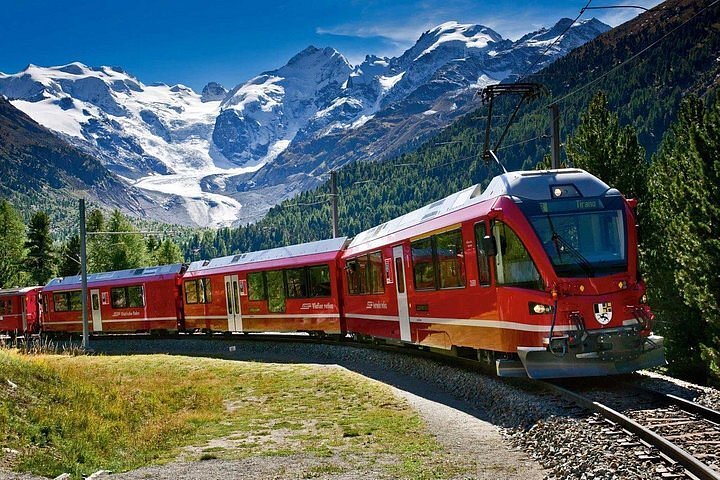
When people picture the best train routes in Europe, they’re often thinking of the Bernina Express. This famous red train carves a path through the Swiss Alps, crossing towering viaducts and passing glacial lakes on its way from Switzerland into Italy. With panoramic windows designed to give you an unfiltered view of the stunning alpine scenery, it’s a bucket-list journey that feels straight out of a movie.
However, not all scenic train routes in Europe require a special ticket. The journey through Germany’s Rhine Valley, between Koblenz and Mainz, is a perfect example. Here, regular regional trains hug the riverbank, offering postcard-perfect views of fairytale castles perched on hillsides and terraced vineyards sloping down to the water. It’s an easy and affordable way to add a magical leg to your trip without the hassle of complex booking.
From the dramatic coastal cliffs of Italy’s Cinque Terre to the misty highlands of Scotland, spectacular views are often a free bonus of choosing the train. These incredible journeys are more accessible than you think.
Travel Europe by Train: First-Timer’s Checklist
A bustling European station can seem intimidating, but finding your train is far simpler than navigating an airport. One of the most crucial first-time train travel Europe tips is to ignore the chaos and focus on the main departure board. This giant screen is your single source of truth. Follow this simple pre-boarding checklist every time:
- Arrive Early: Get to the station at least 30 minutes before your departure time.
- Find Your Train: On the “Departures” board, locate your train number and destination.
- Go to the Platform: About 15-20 minutes before departure, a platform number will appear. This is your track, often labeled Voie (French), Gleis (German), or Binario (Italian).
- Match Your Seat: On the platform, look for a diagram showing the train’s layout to find your coach (car) number, then board and find your reserved seat.
Unlike flying, there’s no luggage check-in; you simply carry your bags onto the train and store them in the racks at the end of the car or above your seat. This streamlined process makes navigating high-speed trains a breeze. Whether you’re in first or second class, the steps are the same—first class just offers a bit more legroom.
Europe by Train: Your Action Plan for an Incredible Train Adventure
You now have the key to unlocking European train travel. Your journey begins with a single, clear choice: the flexibility of a rail pass versus the budget-friendly certainty of individual tickets. So, what’s your next move? Look at your dream itinerary. If it’s a spontaneous, multi-country adventure, explore the Eurail Pass. If your plan involves just a few cities on a set schedule, start pricing point-to-point train tickets to Europe on a booking site.
The question is no longer if you can figure out how to travel Europe by train, but simply where you’ll decide to go first. That dream of watching the countryside roll by is now a clear destination on a map. You’re a planner, ready to make it happen.