Feeling a little overwhelmed by French menus?
You’re not alone. Paris is a food lover’s paradise, but it can be intimidating when you’re not sure what to order. If you’re wondering what to eat in Paris, this simple guide is your cheat sheet to 5 classic foods that will have you ordering confidently and eating authentically, starting with the most iconic breakfast of all.
Must-Try Paris Foods: A Delicious Guide
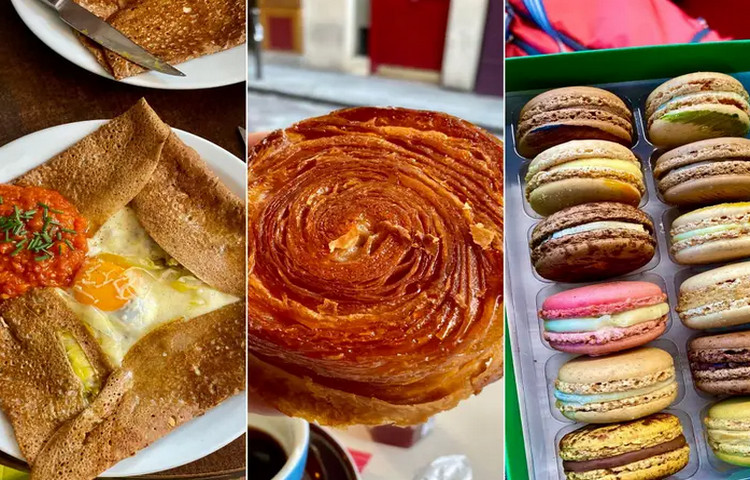
The quintessential Parisian breakfast begins with the croissant. A true Parisian croissant isn’t the dense, bready crescent you might find at home; it’s incredibly light, flaky, and tastes deeply of butter.
The secret is the high-quality ingredients and countless delicate layers. You can spot a great one visually: look for a puffy, golden-brown pastry that looks like it might shatter if you touch it, not something flat, pale, or greasy.
So, where do you find one? Your search for the best croissants in Montmartre, or any neighborhood, should start at a true boulangerie (boo-lawn-zhuh-REE). In France, this isn’t just a generic name for a bakery; it’s a protected title. Common knowledge among Parisians is that a shop can only call itself a boulangerie if it bakes its own bread on-site, a reliable sign of fresh, traditional food in Paris.
Knowing how to order at a Parisian boulangerie is easier than you think. You don’t need to be fluent. Simply walk in, point to that perfect croissant, and say with a smile, “Un croissant, s’il vous plaît” (uhn krwa-sahn, seel voo play). That simple phrase—”One croissant, please”—is your key to enjoying your first, perfect bite of Paris.

2. The Jambon-Beurre: Why This Simple Sandwich is a Parisian Lunch Staple
After a morning of exploring, the question of lunch inevitably comes up. For a truly classic and satisfying Parisian experience, look no further than the jambon-beurre (jhom-bon-burr). It sounds simple—and it is.
This is France’s answer to the ham sandwich, but it’s elevated to an art form, representing one of Paris’s most popular and traditional foods.
The magic of the jambon-beurre isn’t in a long list of ingredients; it’s in the perfection of just three. A fresh, crusty baguette is split and slathered with high-quality, lightly salted French butter, then layered with slices of excellent cooked ham, known as jambon de Paris. It’s a powerful lesson in the French culinary philosophy: amazing ingredients need little help to shine.
Beyond being delicious, this sandwich is one of the best tips for eating in Paris on a budget. It’s an affordable and portable meal beloved by locals, perfect for grabbing on the go or enjoying as a picnic in a park like the Jardin du Luxembourg. You’re not just eating a quick lunch; you’re participating in a daily ritual that makes you feel part of the city. This simple combination represents the heart of everyday Parisian food. When you’re ready to sit down for a different kind of classic meal, a brasserie awaits with another iconic dish.
3. Steak Frites: Your Guide to Ordering at a Classic Parisian Brasserie
When you’re ready for a satisfying sit-down meal that’s woven into the very fabric of Paris, it’s time for steak frites (stek-freet). This classic dish—a perfectly cooked steak served with a generous portion of golden fries—is a hearty, reliable, and utterly delicious staple you’ll find on menus across the city. It’s the kind of meal Parisians turn to for a comforting lunch or a relaxed dinner with friends.
You’ll most often find this dish at a brasserie (brass-uh-REE).
Unlike smaller, more intimate bistros, a brasserie is typically larger, with longer hours and a consistent menu of classics, making it a fantastic and welcoming choice. Whether you’re searching for the best steak frites in the Latin Quarter or find a cozy spot near your hotel, a brasserie is an excellent option.
When ordering, it’s helpful to know that French standards for doneness are rarer than what many travelers are used to. Your waiter will ask how you’d like it prepared, so here’s a simple guide:
- Saignant (seh-nyon) – Rare, with a cool red center.
- À point (ah-pwan) – Medium-rare, with a warm pink center. This is the standard and a safe bet for most people.
- Bien cuit (byan-kwee) – Well-done.
Ordering your steak à point gives you the authentic experience. With that simple phrase, you can confidently order one of Paris’s most iconic meals. After the main course, an equally impressive dessert awaits: the delicate, colorful macaron.

4. The Macaron: How to Spot a Real One and Where to Buy It
After a hearty meal, there’s always room for one of Paris’s most iconic and photogenic sweets. Enter the macaron, one of the classic French desserts to try.
A true French macaron (mah-kah-ROHN) is a delicate sandwich made of two light, almond-flour cookies held together by a rich filling like ganache or jam—not to be confused with the dense, coconut-based macaroon popular in other countries. They are colorful, elegant, and melt in your mouth.
But not all macarons are created equal. A high-quality macaron has a perfectly smooth, crisp shell with a ruffled “foot” at the base.
When you take a bite, the shell should give way to a soft, slightly chewy interior with a generous amount of filling. If you see macarons that are cracked, lopsided, or have a meager smear of filling, it’s best to walk away. The texture and balance are what make this simple cookie an art form.
You won’t typically find the finest examples at a standard bakery. For the absolute best, you need to visit a pâtisserie (pah-tiss-uh-REE).
While a boulangerie is your go-to for daily bread, a pâtisserie is a specialty pastry shop dedicated to the art of dessert.
Think of it as a jewelry store for sweets, often showcasing its beautiful creations in stunning window displays. A guide to Parisian patisseries starts with this one rule: look for the shop that treats its pastries like treasures.
Choosing from the rainbow of flavors—from classic pistachio and chocolate to inventive salted caramel or rose—is all part of the fun.
While these elegant cookies are a perfect afternoon treat, Paris also excels at a much simpler, heart-warming dessert you can enjoy right on the street.

5. Crêpes, Sweet or Savory: Mastering Paris’s Favorite Street Food
For a famous food in Paris that you can enjoy while strolling through charming streets, nothing beats a crêpe. But what many visitors don’t realize is that they come in two distinct styles, each serving a different purpose.
One is a hearty meal, while the other is a perfect sweet snack, making crêpes one of the most versatile Parisian dishes you can find.
First up is the savory version, called a galette (gah-LET). Made from a darker, nuttier buckwheat flour, a galette is thin, crispy at the edges, and typically folded over a delicious filling. It’s substantial enough for a quick and satisfying lunch. A classic order is the complète, which includes ham, cheese, and an egg, but you’ll find plenty of other options. Think of it as France’s answer to the perfect grab-and-go lunch.
Then there’s the one you’re probably picturing: the sweet crêpe sucrée (KREP soo-KRAY). This dessert crêpe is made with a lighter wheat flour and is served with simple, delicious toppings. While you can get them with everything from fresh fruit to whipped cream, the most popular and authentically Parisian choices are Nutella and banana or just a sprinkle of sugar and a squeeze of fresh lemon.
You can find both of these staples at a crêperie (krep-uh-REE). These can be anything from a small walk-up window on a street corner to a cozy sit-down restaurant.
How to Avoid Tourist Traps Restaurants in Paris
Now that you know what to order, the final step is finding the right place to eat. Avoiding trap restaurants in Paris is easier once you know the signs to look for.
- Red Flags (Walk Away): Watch for huge menus translated into five or more languages, giant, laminated photos of the dishes displayed outside, or a host on the street actively trying to lure you inside.
- Green Flags (Give it a Try): Look for a shorter, seasonal menu written primarily in French (maybe with small English subtitles).
Listen for the buzz of locals speaking French inside. The best places are often confident enough to avoid flashy gimmicks.
When in doubt, use the “One-Block Rule.” If you’re standing in front of a major attraction, simply walk one full block away in any direction.
The restaurants on these quieter side streets rely on repeat business from locals, not a constant stream of first-time visitors, so the quality is almost always better. Whether you’re hunting for authentic French onion soup or a perfect steak frites, this simple trick will rarely let you down.
What to Eat in Paris! Your Food Adventure Awaits
Before, a Parisian menu might have seemed like a puzzle.
Now, you hold the key. You know that the perfect day begins with a warm croissant from a boulangerie, and you’re equipped to order it with a smile. This isn’t just a list of foods; it’s your personal map to eating confidently and authentically across the city, transforming your trip into a delicious adventure.
You can now craft your own Paris food tour experience, moving from a simple jambon-beurre for lunch to classic steak frites at a bustling brasserie.
With a guide to Parisian patisseries in your back pocket, you know exactly where to find those delicate macarons. The question of what to eat in Paris is no longer a worry, but an exciting series of choices you’re prepared to make.
The real goal was never to get every order “perfect”—it’s to find joy in the discovery.
Trust your newfound knowledge, be curious, and don’t be afraid to simply point at what looks delicious. Paris is a feast for the senses, and you are now officially ready to take your seat at the table. Enjoy every single bite.